Salesforce Commerce Cloud (SFCC) isn’t just a platform..
It’s a growth engine for ambitious brands. But navigating its full potential takes more than licensing and configuration. That’s where Levi9 comes in.
We’ve built our reputation helping companies like ASICS deliver scalable, high-performing digital commerce experiences. Whether you’re starting from scratch or optimizing an existing SFCC setup, we bring the structured approach and hands-on expertise needed to create measurable impact.
From greenfield implementation to migration and enhancement, our work spans the entire spectrum:
- Moving brands from legacy SiteGenesis setups to modern headless architecture
- Building loyalty systems that integrate physical and digital retail.
- Implementing personalised AI-driven product recommendations with Einstein.
And with every project, we apply the same structured approach: our 9-step delivery model. It’s agile enough to adapt to changing priorities, but grounded enough to deliver results at scale. Behind it is a team of certified Salesforce Commerce experts: architects, engineers, and integration specialists who understand both the tech and the business behind ecommerce.
A Structured Approach to Ecommerce Success
We believe that success with SFCC starts with structure. That’s why every Levi9 engagement follows a nine-step framework from discovery to optimisation. It helps us move fast without losing quality, and gives our clients the confidence to scale.
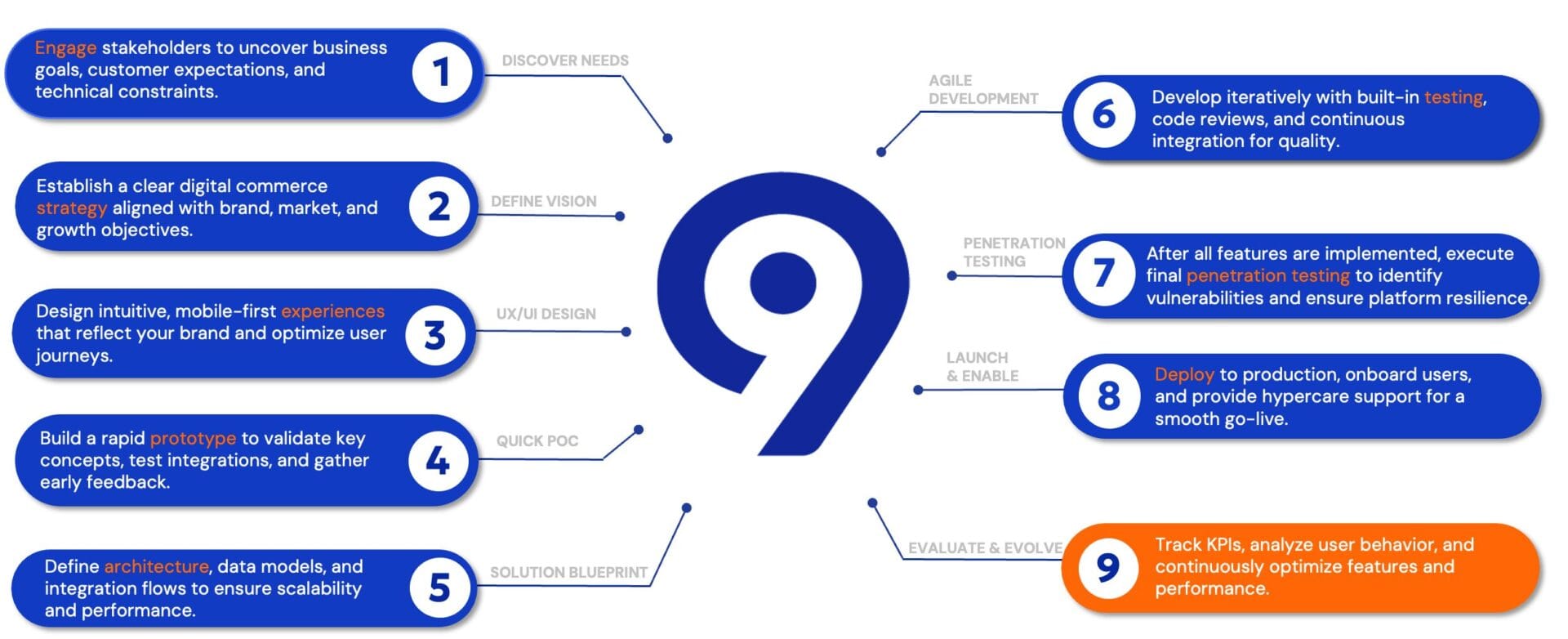
- Discover Needs: Engage stakeholders to uncover business goals, customer expectations, and technical constraints.
- Define Vision: Establish a clear digital commerce strategy aligned with brand, market, and growth objectives.
- UX/UI Design: Design intuitive, mobile-first experiences that reflect your brand and optimize user journeys.
- Quick POC: Build a rapid prototype to validate key concepts, test integrations, and gather early feedback.
- Solution Blueprint: Define architecture, data models, and integration flows to ensure scalability and performance.
- Agile Development: Develop iteratively with built-in testing, code reviews, and continuous integration for quality.
- Penetration Testig: After all features are implemented, execute final penetration testing to identify vulnerabilities and ensure platform resilience.
- Launch & Enable: Deploy to production, onboard users, and provide hypercare support for a smooth go-live.
- Evaluate & Evolve: Track KPIs, analyze user behavior, and continuously optimise features and performance.
This model lets us onboard quickly, collaborate clearly, and deliver results faster, whether we join your internal team or run the build ourselves.
What That Looks Like in Practice
We’ve seen firsthand what happens when structure meets capability.
One client needed to modernize their site but didn’t know where to start. They had performance issues, scattered UX patterns, and a loyalty program that only worked offline. We restructured their frontend with a headless architecture, rebuilt PDPs and PLPs for speed, and integrated their loyalty program into the online journey.
The result? Faster site speed. Higher engagement. Increased order value. Happier customers.
In another project, we migrated a brand from SiteGenesis to SFRA, then to headless. All while introducing personalisation with Einstein AI. Today, their marketing team can run campaigns faster, their storefront responds better, and the entire experience feels cohesive.
Built for Every Stage of Growth
Wherever you are in your SFCC journey, we tailor our involvement to match.
Just starting out? We lead greenfield implementations from strategy to deployment. Already live? We optimise what you have. Enhancing features, improving performance, and accelerating delivery. Scaling fast? We support complex migrations, multi-store rollouts, and custom backend logic.
And we do it as a partner, not just another delivery vendor.
Certified to Deliver
Behind every success story is a team that’s done the work. At Levi9, that means certified people doing what they do best:
In this article: