In today’s fast-moving business world, AI is no longer just a technological innovation but a fundamental driver of strategic leadership. In 2025, the most successful leaders are no longer just strategic thinkers, they are AI change agents, that balance technological acceleration with human values.
The intersection of AI and leadership is creating new patterns for how organizations are managed, how decisions are made, and how businesses compete in this digital world. By blending Agile’s manifesto with LLMs, GenAI and conversational agents, leaders can empower teams to move faster, learn smarter, and innovate with empathy.
But leaders must do so by keeping the human connection at the heart of anything in order to make Agile work in the first place. AI brings several capabilities that enhance delivery, like backlog prioritization (eg. JIRA AI. StoriesOnBoard; airfocus), sprint forecasting (ClickUp AI), and sentiment analysis (eg. TeamRetro; Microsoft Viva Insights). But Agile wasn’t built for automation; it was built for adaptability, collaboration, and people-first problem solving. The question isn’t whether to integrate AI, it’s how to do so without compromising Agile values.
There are some key drivers behind the transformation, as:
- Faster decision-making driven by real-time insights
- Enhanced pattern detection in velocity and team dynamics
- Scalable learning through personalized knowledge management
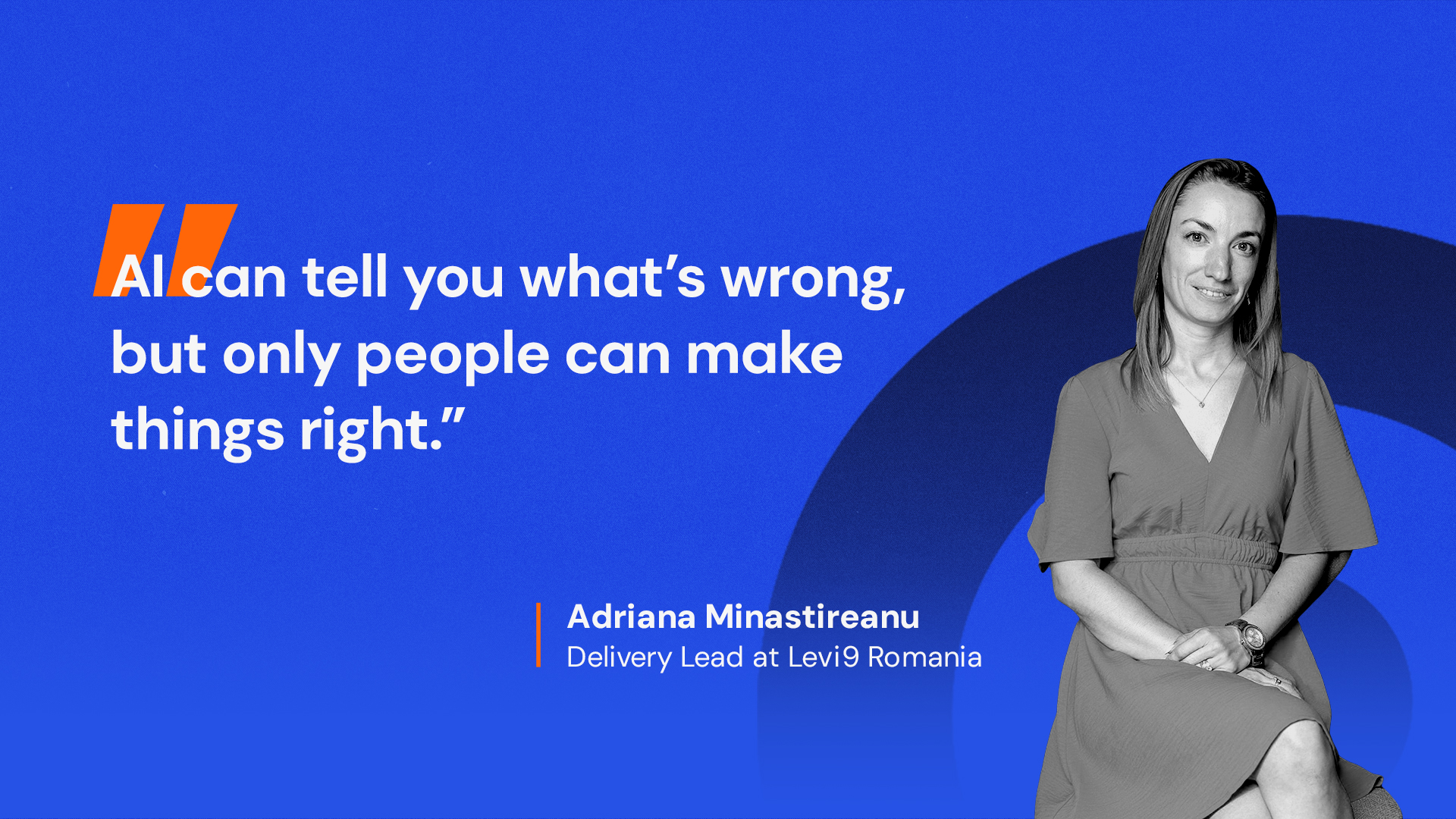
AI can make Agile faster. But left unsupervised, it risks depersonalizing teams and lower creative problem-solving. The solution? A people–first leadership approach that sees AI as a partner, not a replacement.
Three leadership roles in the AI-Agile era
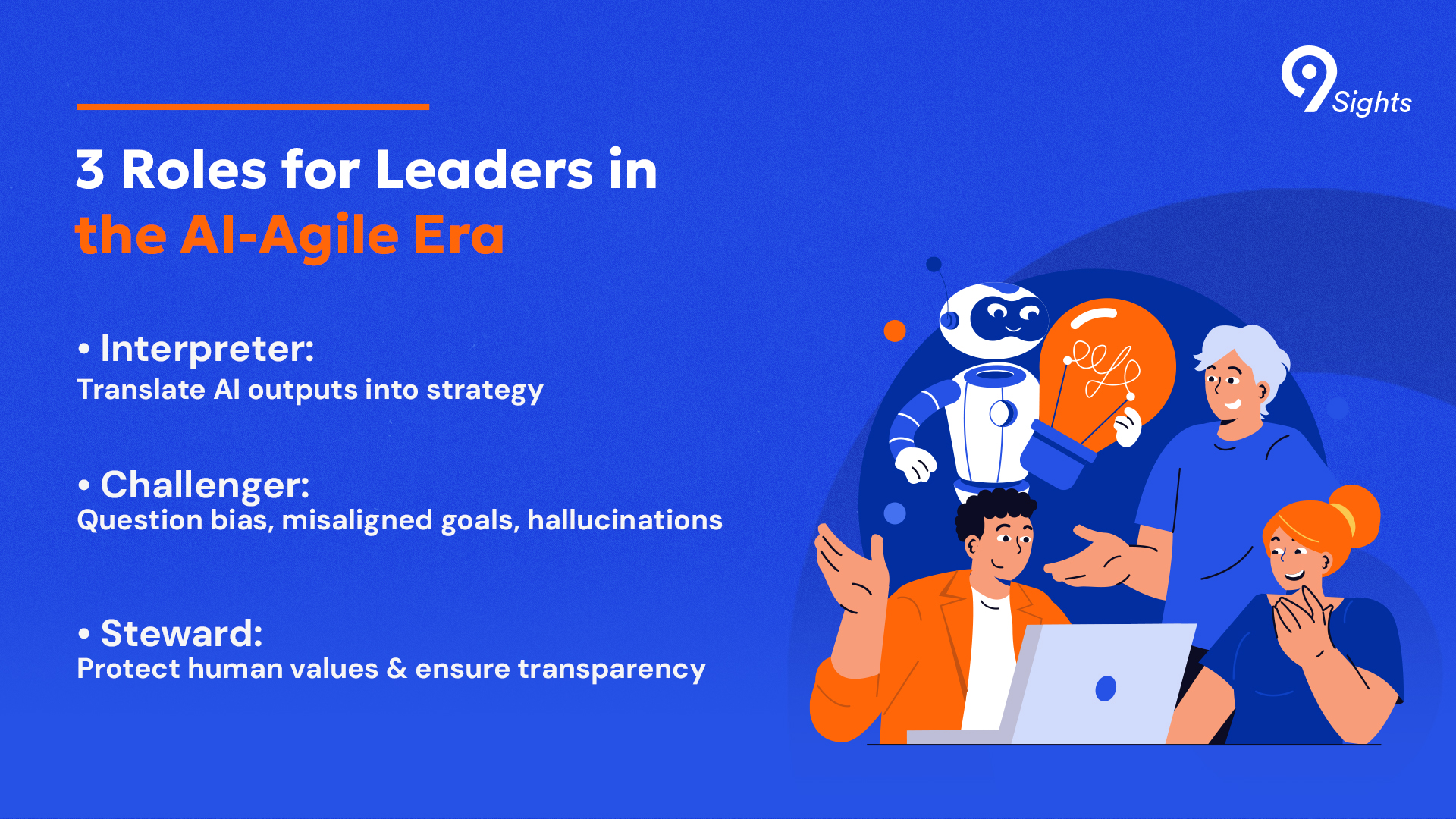
The nature of leadership is being redefined in the age of AI. Modern leaders are required to take new roles that shape how AI is integrated into the organizational life. Now they must wear three hats:
Interpreter – Leadership starts with understanding context, so they have to translate AI outputs (e.g., velocity prediction, sprint anomalies, or user stories generated by LLMs) into strategic decisions. Think of the Product Owner who is using AI to create backlog items but is still applying his domain knowledge and empathy to prioritize the items along with the strategy.
Challenger – interpretation must be followed by the willingness to challenge AI recommendations. Top leaders must question intelligent tools by:
- Identifying bias
- Spotting misaligned objectives
- Identifying hallucinated AI outputs
This role ensures AI aligns with team ethics and goals. For example, ignore sprint goal suggestions that conflict with known capacity constraints.
Steward – beyond interpretation and willingness to challenge lies the responsibility to protect the human values, transparency and accountability. This includes reinforcing psychological safety in AI workflows.
Research studies show that at Microsoft, Scrum Masters use AI tools to assist in meetings, while final decisions remain collective. At Spotify, AI supports retrospectives by identifying themes, while facilitators lead emotionally intelligent conversations.
Frameworks that make AI work for Agile
Beyond leadership roles, there are also frameworks that make AI work for Agile, as follow:
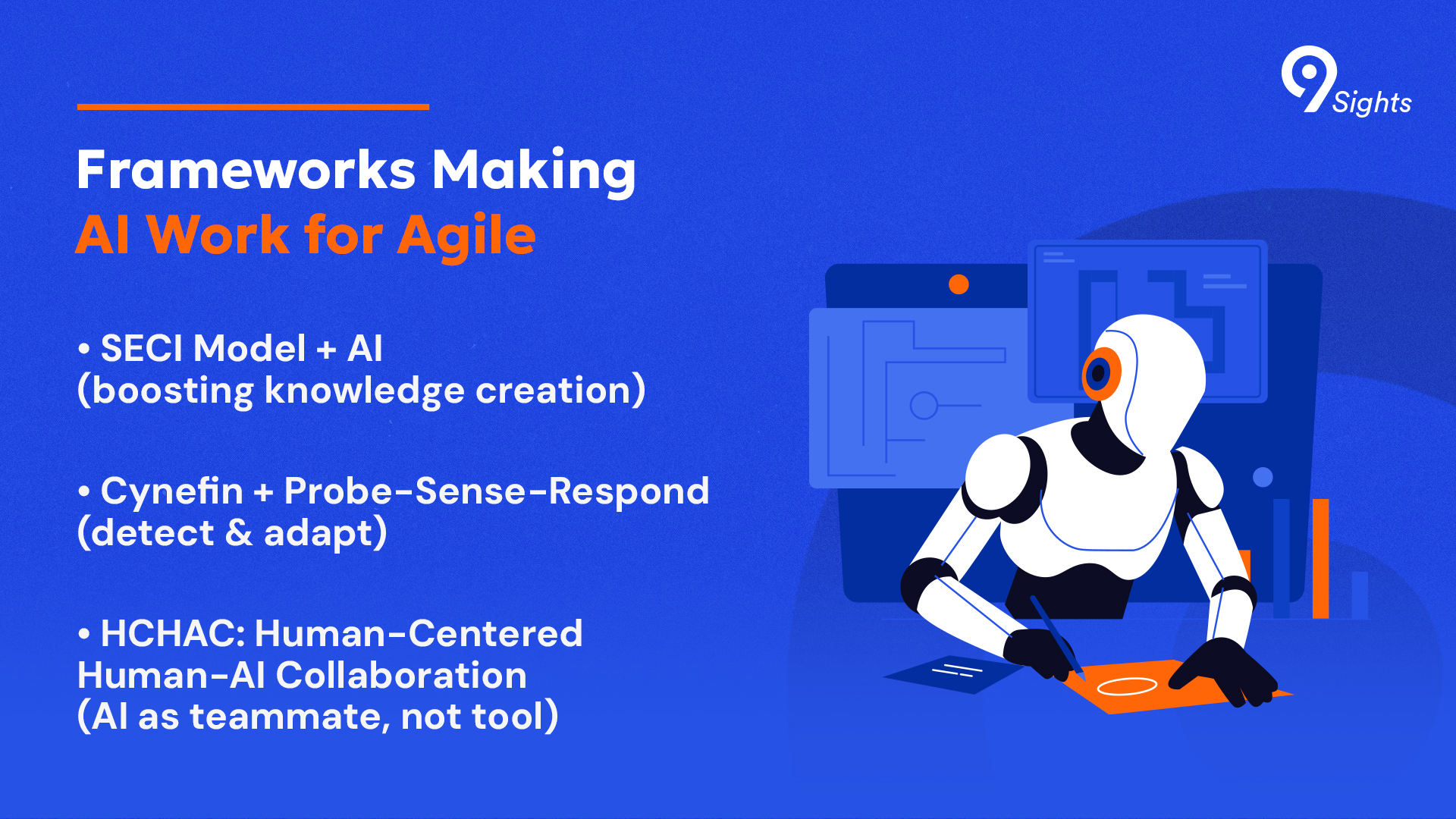
SECI Model + AI
The SECI model, originally created to explain how knowledge is created in teams, comes now integrated with AI that expands and accelerates team learning, by boosting all four knowledge dimensions:
- Socialization: Sentiment analysis tools (eg, TeamMood, CultureAmp) uncover tacit emotional knowledge
- Externalization: Transcription tools (Otter.ai, Zoom AI companion) convert raw team thoughts into structured notes
- Combination: ML tools (Jira Advanced Roadmaps) merge data from multiple sources, identifying patterns and making predictions
- Internalization: Personalized learning agents (Sana, Degreed) accelerates onboarding and adaptive learning experiences. McKinsey forecasts a 20% drop in onboarding time by 2027.
Cynefin + ProbeSenseRespond
In complex Agile environments, AI acts as a “cognitive sensor” and can detect sprint bottlenecks or delivery delays early, suggesting small experiments (e.g., reassignment) with clear feedback loops.
HCHAC (Human-Centered Human-AI Collaboration)
This emerging model reframes AI agents as teammates, not tools. Humans keep decision authority to ensure Agile ceremonies like standups or refinement remain relational. For example, Slack’s GPT bot, or GitHub Copilot in planning ceremonies, are embedded as team consultants and never as decision-makers.
The Future: AI co-creation in Agile teams
The future is not AI assistance, but AI co-creation. Agile teams in 2027 may look like:
- A GenAI Product Owner assistant summarizing user interviews into prioritized backlog items.
- LLM retrospectives combining team sentiment logs, code velocity patterns, and Git comments to suggest learning topics.
- Conversational agents embedded in standups, raising blockers based on yesterday’s updates and Git merge history.
However, this vision requires more than technology, it needs clear governance, team training in AI use, and adoption of mechanisms to ensure comfort and transparency.
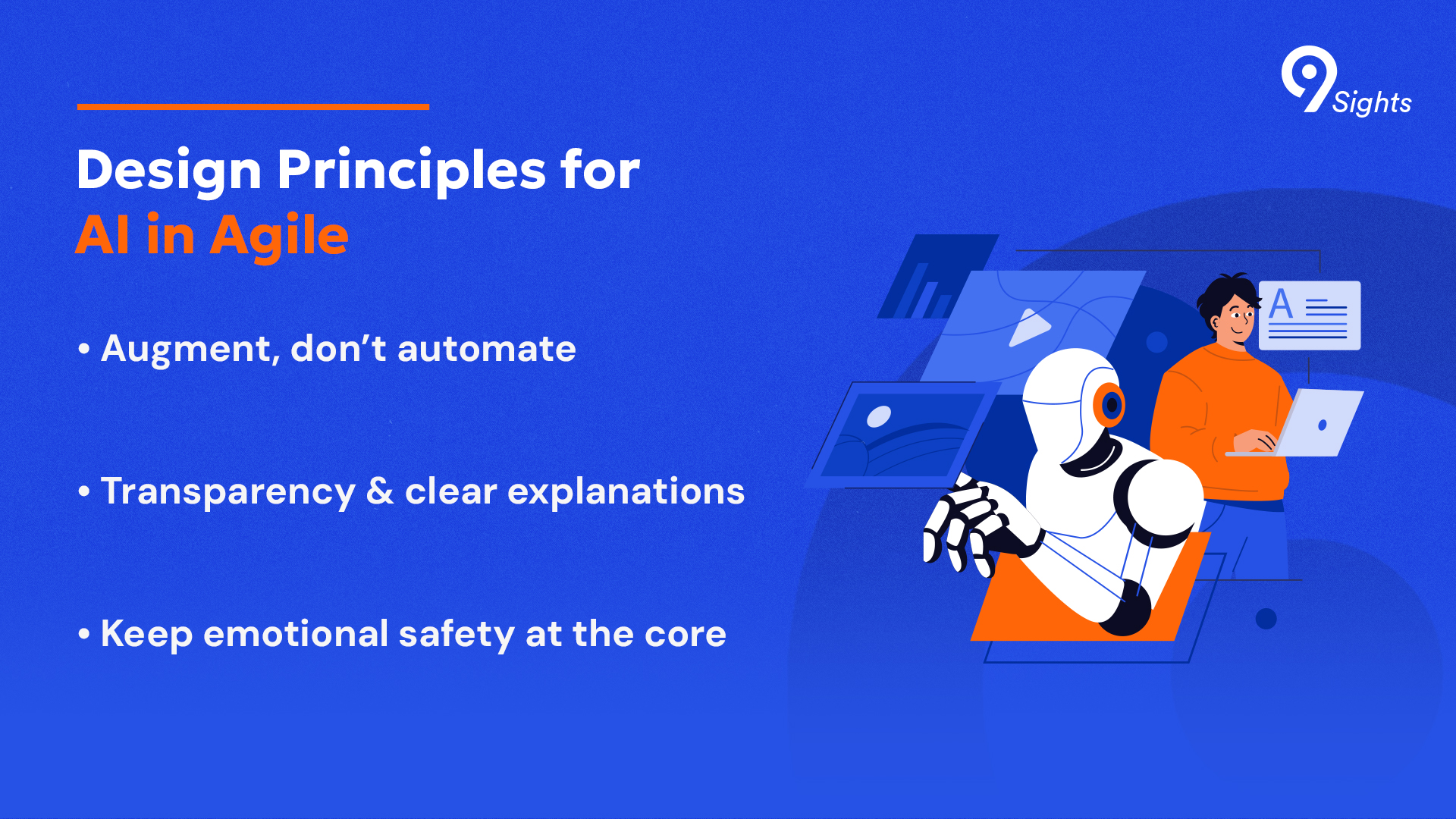
Design principles for AI in Agile
To make sure we build a culture of augmentation, and not automation, leaders should embrace the following design principles:
Augment, Don’t Automate
Use AI for suggestions and not for decisions. For example, let AI propose backlog items and the team to choose what is good for the project. Microsoft used AI to assist Product Owners in estimating backlog items more accurately and not as a decision maker.
Transparency and explanations
Ensure AI outputs (e.g. estimations, risk forecasts) are transparent. Use “Model Cards” (what it does; data sources; biases and limits; how it evolves) for any AI outputs used in retrospectives, sprint planning, or customer research by summarizing what the AI does, what data it uses, and its limitations.
Keep Emotional Safety Space
AI must be paired with emotional intelligence tools (TeamRetro; Microsoft Viva) such as team sentiment analysis used for improving psychological safety.
Leadership is no longer about choosing between Agile and AI, it’s about mastering both with conscience. The best leaders won’t be the ones who integrate the most AI tools, but those who ask the right questions, who stay curious, who train their people to challenge machine output, who govern their AI tools, and protect their culture.
We, as leaders, must ensure that we move in the right direction.